
Indonesia’s JCI Plunges 11.57% Over MSCI: What Happened and What Should Investors Do?
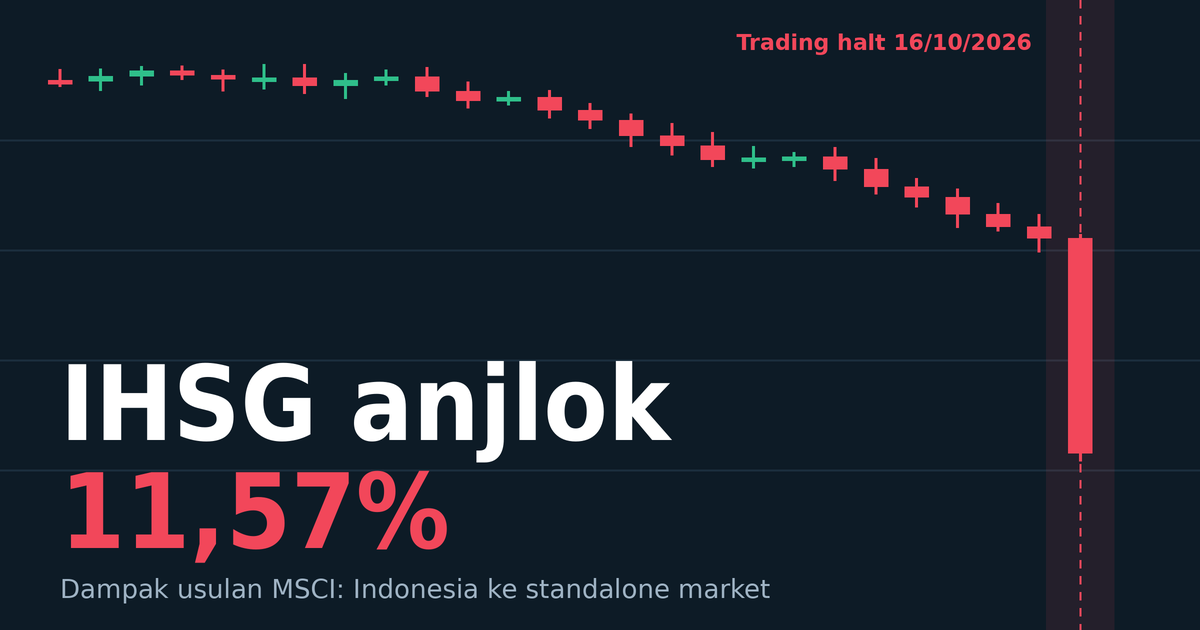
Indonesia’s stock market is in turmoil. The IHSG, known internationally as the Jakarta Composite Index (JCI), fell sharply in mid-October 2026 after index provider MSCI announced a consultation on downgrading the country’s market status. This article covers the timeline, the reasons, the impact, and what investors should watch next.
What is MSCI, and why does it matter so much?
MSCI is a global index provider whose benchmarks are tracked by many of the world’s fund managers. A country’s classification (developed, emerging, or frontier market) shapes how much foreign capital is allowed, or willing, to enter its stock market. Funds mandated to hold only emerging-market stocks may be forced to sell Indonesian shares if the country is downgraded.
Timeline: January to October 2026
January 28, 2026. The JCI opened down 6.69% at 8,379.41 after MSCI announced the results of its consultation on free-float rules for Indonesian stocks. MSCI also froze index adjustments for Indonesian stocks with immediate effect. The reason: MSCI considered ownership transparency in Indonesia insufficient. bisnisbisnis
June 24, 2026. MSCI kept Indonesia in the Emerging Market category but noted that market participants had raised deep concerns about investability. The JCI closed down 3.56% at 5,883.88. In the same round of reviews, MSCI cut Indonesia’s Information Flow rating from “+” to “-”. bisnisbisnis
August 2026. At the August 12 Annual Country Review, MSCI again kept Indonesia in the emerging market category, with a reform deadline of November 2026. maybanktrade
October 15–16, 2026. The most dramatic moment. MSCI announced a consultation period on October 15, and the next day the JCI fell 11.57%, one of the deepest single-day drops since the 1998 financial crisis. Trading was briefly halted, and the index closed at 5,185.10, its lowest level since 2020. cnbcindonesiaidntimes
What is a “standalone market”?
This is what shocked investors. The proposal is no longer just a drop to frontier market status. Coordinating Minister Airlangga explained that the standalone category sits between frontier and emerging markets. MSCI has proposed the change, with a final decision due no later than June 30, 2027. So this is still a proposal, not a final decision. cnbcindonesiaidntimes
Impact on the market and investors
- Foreign selling. Foreign investors had already net sold Rp84.8 trillion of Indonesian stocks year to date through October 15, 2026, before the reclassification proposal was announced. idntimes
- Shrinking weight. Indonesia’s estimated weight in the MSCI Emerging Markets index was about 0.43% as of September 30, 2026, down from 1.15% at the end of 2025. That is a change in index share, not a 62% fall in the JCI. harianbasis
- Market value erosion. As of October 14, the index was down 31.14% year to date, and market capitalization had shrunk by Rp5,548 trillion from its December 2025 peak. That figure predates the October 16 drop. cnbcindonesia
- Other pressures. Analysts also cite geopolitical escalation and a hawkish outlook from the Fed as limits on any recovery. cnbcindonesia
What should investors watch next?
- The MSCI November 2026 Index Review. MSCI’s official calendar lists the announcement for November, with regular changes effective December 1. Exact dates can differ between media reports because of time zones, so confirm with official sources. cnbcindonesia
- The fate of the index freeze. Analysts at Mirae Asset Sekuritas expect the freeze won’t be lifted at the November review. harianbasis
- Regulator action. The IDX and KSEI are widening checks on shareholder ownership data, and government and parliament have responded. Transparency reform is what MSCI is asking for.
- Bank Indonesia’s rate decision. The central bank’s Board of Governors meeting is scheduled for October 20–21, 2026. idntimes
Should retail investors panic?
There is no single answer, and this article is not a buy or sell recommendation. One view holds that the threat need not be a cause for excessive worry among domestic investors, since foreign investors’ decisions are not determined by MSCI alone. Still, the risk is real and volatility may continue. Some basics always apply: investortrust
- Don’t decide out of panic or FOMO.
- Invest only money you won’t need for years, never your emergency fund.
- Diversify across assets and sectors.
- Check company fundamentals instead of just following the index.
- Avoid leverage or margin in highly volatile conditions.
FAQ
Has Indonesia officially been downgraded?
No. This is an MSCI proposal still under consultation, with a final decision due by June 30, 2027.
Why did the index fall so far in a single day?
Markets reacted to fears of foreign capital outflows, on top of negative sentiment that had been building all year.
When is the next MSCI review?
November 2026, with regular changes effective December 1, 2026.
Is this the same as the 1998 crisis?
The one-day drop ranks among the deepest since 1998, but the causes and economic fundamentals differ, so comparisons need care.
Disclaimer: This article is for information and education only. It is not an invitation to buy or sell any security. Investment decisions are your own responsibility.




1 Comments
Comments are closed.